Tuesday, 27 September 2016

FAQ III 


The  Income   Declaration Scheme,  2016  (hereinafter referred to  as  ‘the  Scheme’ ) incorporated as Chapter IX of the  Finance  Act, 2016 provides an opportunity to persons who  have  not  paid  full  taxes  in the  past  to  come  forward and  declare the  undisclosed income  and  pay tax, surcharge and  penalty totaling in all 45% of such undisclosed income declared. The Income  Declaration Scheme  Rules,  2016 (hereinafter referred to as ‘the IDS Rules’) have been notified. In this regard, Circular No. 17 of 2016 dated 20 th  May, 2016 and Circular No. 24 of 2016 dated 27 th  June, 2016 issued by the Board provided clarifications to 14 and  11 queries respectively. Subsequently, further queries have  been received from the public  about  various provisions of the  Scheme.

The Board  has  considered the  same  and the following clarifications are issued.-   

Question No.1:         Will   the  information contained in  the  declaration be  shared  with other law  enforcement agencies? 

Answer:          
No; the  information contained in the  declaration shall  not  be shared with  any  other  law  enforcement agency.    The  information will  also not  be   shared   within   the    Income    Tax   Department   for    any investigation in respect of a valid  declaration.   

Question No.2:         Whether   immunity will  be  provided  under  other   economic   laws including  Service Tax, VAT, Companies Act,  SEBI Act & regulatio ns etc.? 

Answer:    
The Scheme  provides immunity under the  Income-tax Act, 1961, the Wealth-tax Act, 1957 and  the  Benami  Transactions (Prohibition) Act, 1988. Immunity from Benami Transactions (Prohibition) Act is subject to the condition that  the property will be transferred to the declarant (being  the  person who  provided the  consideration for the  property) latest  by 30th September, 2017.  However, as mentioned in response to Question No.1 above,  the information contained in the declaration made  under the Scheme  will not be shared with  any  other  tax or law enforcement agency.   
        
Question No.3:         Where the value  of immovable property determined  under Rule 3 of the IDS Rules is lower  than the value  adopted or ass ess ed/ass essable by stamp valuation authority referred in section 50C or section  43CA of  the  Income-tax  Act,  whether   value   of  such  property  is  to  be declared as per Rule 3 of the IDS Rules, or as per section  50C/43CA? 

Answer:

The  value  of  the  property for  the  purposes of  declaration in  such cases  shall  be computed as per  Rule  3 of the  IDS Rules  even  if such value   is  lower   that   the  value   adopted  or  assessed/assessable  by stamp valuation authority.
  
Question No.4:         Whether  credit for tax deducted,  if any, in respec t of income declared shall be allowed?
  
Answer:                     Yes; credit   for  tax  deducted shall  be  allowed only  in  those  cases where the related income  is declared under the Scheme and  the credit for the  tax has  not  already been  claimed in the  return of income  file for any assessment year. 

Question No.5:         Where a valid declaration is made after making  valuation as per the provisions of the Scheme read with IDS Rules  and tax,  surcharge & penalty  as  specified   in  the  Scheme  have  been  paid,   whether   the department will make  any  enquiry  in respect of sources  of  income, payment of tax, surcharge and penalty? 

Answer:                     No . 


Question No.6:         What is the purpose of obtaining the information about the nature of undisclosed income in the last  column of table  at point  (I) relating  to nature of undisclosed income in Annexure to Form-1? 

Answer: 
The purpose of obtaining information about  the nature of undisclosed income  is to know  whether the undisclosed income  is in the  form  of moveable asset,  immovable asset,  gold,  jewellery  or  cash.  Here,  the nature of income  need  not  be  confused with  the  source  of income. There is no need  to indicate the source  of income  at all. In the column meant  for   nature  of  undisclosed  income   one   has   to   write   the nomenclature such  as  ‘immovable  property’,  ‘moveable  property’, ‘gold’,  ‘jewellery’  or  ‘cash’  etc.  This  will   enable   the   taxpayer  to establish the link between the income  declared under the scheme  and the  claim,  if any,  made  in respect of such  undisclosed income  in the return of income  filed subsequently or during any assessment proceedings. 

Question No.7 :         In case  the  value  of immovable property is evidenced  by  registered deed, whether  the value  as per registered  deed or the market value  as on 01.06.2016 is to be declared? 

Answer:                     As per Rule 3 of the IDS Rules, the fair market value  of an immovable property shall be the higher of its cost of acquisition and the price that the property shall ordinarily fetch if it is sold in the open  market as on 1st June,  2016. The  value  mentioned in the  registered deed  shall  be relevant for determining the  cost of acquisition and  the  same  can be taken  as the  fair market value  only  where it is higher than  the  price that  the  property shall  ordinarily fetch  if sold  in the  open  market as on 1st June, 2016.
  
Question No.8:         In case  a declaration relating  to  investment  in undisclosed asset is made  under the Scheme, whether  any  investigation will be initiated against the seller in respec t of such declaration? 

Answer:                     No. 

Question No.9:         What are the ad vantages of the Scheme as against declaring  the past undisclosed income  as  current income  in the  return of income  to  be filed for Assess ment Year 2017-18? How will the Department identify the year in which the undisclosed income was  earned. 

Answer: 

 In this regard, the following points may be noted:  
• Declaration  of  past   undisclosed income   in  the  current year amounts to false  verification of return of income  which  shall attract prosecution under the Income-tax Act.  
• If anyone attempts to disclose  past  undisclosed income  in the current year,  he will have  to explain the source  of income  and substantiate the manner of earning the said  income.  In case of disclosure under the  Scheme,  there  is no  need  to explain the source of income.  
• Declaration  of  past   undisclosed income   in  the  current year cannot  explain  assets   acquired  in  the  past   or  provide  any immunity in respect of the same.  
• The  Income-tax Department  is  in  receipt  of large  volume of information   from    various   sources  such    as   registrars   of property, banks,  financial institutions, stock exchanges, tax deductors etc. The Department has launched a comprehensive data-mining and  compliance management programme in  the form  of ‘Project Insight’ which  will generate a large  volume of reliable  information about  financial transactions undertaken by taxpayers and  the  relevant year  in which  the  transaction was undertaken.       

Question No.10 :       In a case the dec larant earned undisclosed income  of Rs.  90 lakh  in previous year  2010-11. Out of the  same,  he acquired  an immovable property in the previous year  2011-12 for Rs.50 lakh,  made  personal expenditure  to the extent  of Rs.20 lakh and balance  Rs.20 lakh is left with him as cash in hand on 01.06.2016. The fair market value  of the immovable  property  as  on  01.06.2016  is  Rs.80  lakh.  What  is  the amoun t to be declared under the Scheme?    
Answer:
The declarant in this case has to declare the following: (i)     Rs. 80 lakh being  fair market value  of the immovable property as on 01.06.2016 (ii)       Rs. 20 lakh being the cash in hand as on 01.06.2016 (iii)    Rs. 20 lakh  being  the  balance  of undisclosed income  [Rs. 90 lakh  – (Rs.50 lakh  + Rs. 20 lakh)]  which  is not  represented in the form of investment in any asset.  
Thus  the total  undisclosed income  to be declared in this case will be Rs. 1.20 crore.      
    
Question No.11:       A person invested his undisclosed income in a house property in the previous year  2010-11 which  has  not been let out. The person  also owned   another  house  property from  disclosed sources,  which   has been   claimed    as    self-occupied   property   for   the    purposes    of computation of income  under the head income  from house property. In case the person declares  the undisclosed house property at its  fair market value  on  01.06.2016, whether   any  action  will be  taken  for bringing  the  annual  value   of  the  undisclosed property  to  tax  as income  from  house  property  by  deeming  it to  be  let  property as provided under section  23(4)(b) of the Income-tax Act for the earlier previous years?   

Answer:
No.  However, where  the   house   property  was   let-out   during  the relevant period, the actual  rent received or receivable will be required to be declared under the Scheme  in addition to the fair market value of the house  property as on 01.06.2016.
Clarifications on the Income Declaration Scheme,  2016  

The  Income   Declaration Scheme,  2016  (hereinafter referred to  as  ‘the  Scheme’ ) incorporated as Chapter IX of the  Finance  Act, 2016 provides an opportunity to persons who  have  not  paid  full  taxes  in the  past  to  come  forward and  declare the  undisclosed income  and  pay tax, surcharge and  penalty totaling in all 45% of such undisclosed income declared. The Income   Declaration Scheme Rules, 2016 (hereinafter referred to as ‘the Rules’) have been  notified. In this regard, Circular No.  17 of 2016 dated 20 th  May,  2016 issued by  the  Board  provided clarifications to  14 queries. Subsequently, further queries have been received from the public  about  various provisions of the  Scheme.  The Board has considered the same and the following clarifications are issued.- 
Question No.1 :         If only  part  pa yment  of the  tax,  surcharge  and  penalty payable on undisclosed  income   declared   under   the   Scheme   is   made   before 30.11.2016, then  whether  the  entire  declaration fails  as  per  sec tion 187(3) of the Finance Act, 2016 or pro-rata declaration on which  tax, surcharge and penalty has been paid remains valid? 
Answer:                     In  case  of  part   payment,  the  entire   declaration  made   under  the Scheme  shall  be invalid . The declaration under the  Scheme  shall  be valid  only  when  the complete payment of tax, surcharge and  penalty is made  on or before 30.11.2016. 
Question No.2:         In case of amalgamation or in case of conversion of a company into LLP, if the amalgamated entity or LLP, as the case may  be, wants to declare for the year prior to amalgamation/conversion, then whether a declaration is to be filed in the name of amalgamated entity/LLP or in the name of the amalgamating company or company existing  prior to conversion into LLP? 
Answer:                     Since the amalgamating company or the company prior  to conversion into  LLP is no  more  into  existence  and  the  assets/liabilities  of such erstwhile entities  have  been  taken  over  by the  amalg amated company/LLP, the  declaration is  to  be  made   in  the  name   of  the amalgamated company or the LLP, as the case may be, for the year in which  the amalgamation/conversion takes place. 
Question No.3:         Whether the Scheme  is  open  only  to residents or  to  non -residents also? Answer:                     The Scheme is available to  every  person, whether resident or  non- resident.  
  
Question No.4:         If undisclosed income  relating  to  an ass essment  year  prior  to  A.Y. 2016-17, say  A.Y. 2001-02 is detected after  the closure of the Scheme, then what shall be the treat ment of undisclosed income so detected?  
Answer:                      As per  the provisions of section  197(c) of the Finance  Act, 2016, such income  of A.Y. 2001-02 shall  be  assessed in  the  year  in  which  the notice  under section  148 or 153A or 153C, as the case may  be, of the Income-tax Act  is issued by  the  Assessing Officer.  Further, if such undisclosed income  is detected in the form of investment in any asset then  value  of such  asset  shall  be as if the  asset  has  been  acquired or made  in the year in which  the notice under section  148/153A/153C is issued and  the value  shall be determined in accordance with  rule 3 of the Rules . 
Question No.5:         Whether  a  person  on whom  a  search  has  been conducted  in  April, 2016 but notice  under section  153A is not served  upto  31.05.2016, is eligible  to declare undisclosed income under the Scheme? 
Answer:                     No, in such  a case time  for issuance of notice  under section  153A has not  expired. Hence  the  person is not  eligible  to avail  the  Scheme  in respect of assessment years  for which  notice  under section  153A can be iss ued. 
Question No.6:         As per Circular No.17 of 2016, question No.14, it is not mandatory to attach the valuation report. But Form-1 states “attach valuation report”. How to interpret? 
Answer:                     It is necessary for the declarant to obtain  the valuation report but it is not mandatory for him  to attach  the same  with  the declaration made in  Form-1.     However,    the     jurisdictional     Pr.    Commissioner/ Commissioner in order to ascertain the correctness of the value  of the asset quoted in Form-1 may require the declarant to file the valuation report before issuing the acknowledgment in Form-2. In such a circumstance, it will be necessary for the declarant to make  the report available to the Pr. Commissioner/Commissioner.   
Question No.7:         Is it mandatory to furnish PAN in the Form of declaration?  
Answer:                      Yes, PAN  is the unique identifier for all direct tax purposes. This is also necessary in order to claim the benefits and immunities  available under the Scheme.
    
Question No.8:         If any proceeding is pending before the Settlement Commission, can a person be considered  eligible for the Scheme?  
Answer:                     No,  a  person  shall   not  be  eligible   for  the  Scheme   in  respect  of assessment years  for  which  proceeding is pending with  Settlement Commission.    
Question No.9:         Land is acquired  by  the assessee  in year  2001 from assessed income and  is  regularly  disclosed in return  of income.  Subsequently in the year   2014,  a  building   is  constructed  on  the   said   land   and   the construction cost is not disclosed by the assessee.  What shall  be the fair market value of such building  for the purposes  of the Scheme?  
Answer:                     Fair  market  value   of  land   and   building  in  such   a  case  shall   be computed in  accordance with  Rule  3(2) by  allowing proportionate deduction in respect of asset acquired from assessed income.    
Question No.10 :       Whether   cases   where   summons   under  section   131(1A)  have   been issued  by  the  Depa rtment or letter  under the Non-filer  Monitoring System (NMS) or under section  133(6) are issued  are eligible  for the Scheme?  
Answer:                       Cases where summons under section  131(1A) have been issued by the department or letters  for enquiry under NMS or under section  133(6) are issued but no notice  under section  142 or 143(2) or 148 or 153A or 153C [as specified in section  196(e)] of the Finance  Act, 2016 has been issued are eligible for the Scheme.
  
Question No.11:       If  notices   under  section 142,  143(2)  or  148  have  been  issued  after 31.05.2016  and  assessee   makes  declaration under  the  Scheme  then what shall be the fate of these notices?  
Answer:                     As  clarified   vide   Explanatory Circular  No.  17  dated 20.5.2016  ,  a person  shall   not   be   eligible   for   the   Scheme   in   respect  of   the assessment year  for  which  a notice  under section  142, 143(2) or  148 has  been  received by  him  on  or  before  31.5.2016. In  a  case  where notice  has  been  received after  the  said  date,  the  assessee   shall  be eligible   to   make   a   declaration  under  the   Scheme   for   the   said assessment year.    Such  declaration shall  be  valid  if it has  not  been made  by  suppression of facts  or  misrepresentation and  the  amount payable under the  Scheme  has  been  duly  paid  within the  specified time.  On furnishing by the  declarant the  certificate issued by the  Pr. Commissioner/Commissioner in Form-4  to the Assessing Officer, the proceedings initiated vide notice under section  142, 143(2) or 148 shall be deemed to have been closed.
FAQs on the Income Declaration Scheme, 2016  


The Income Declaration Scheme, 2016 (hereinafter referred to as ‘the Scheme’) incorporated as Chapter IX of the Finance Act, 2016 provides an opportunity to persons who have not paid full taxes in the past to come forward and declare the undisclosed income and pay tax, surcharge and penalty totaling in all the 45% of such undisclosed income declared. The Income Declaration Scheme Rules, 2016 (hereinafter referred to as ‘the Rules’) have been notified. In regard to the scheme queries have been received from the public about the scope of the scheme and the procedure to be followed. The Board has considered the same and decided to clarify the points raised by issue of a circular in the form of questions and answers as follows.-

Question No.1:
Where an undisclosed income in the form of investment in asset is  declared under the Scheme and tax, surcharge and penalty is paid on  the fair market value of the asset as on 01.06.2016, then will the  declarant be liable for capital gains on sale of such asset in the  future?  If  yes,  then  how  will  the  capital  gains  in  such  case  be  computed?

Answer:
Yes, the declarant will be liable for capital gains under the Income-tax  Act on sale of such asset in future. As per the current provisions of  the Income-tax Act, the capital gains is computed by deducting cost of  acquisition from the sale price. However, since the asset will be taxed  at its fair market value the cost of acquisition for the purpose of  Capital Gains shall be the fair market value as on 01.06.2016 and the  period of holding shall start from  the said date  (i.e. the date  of  determination of fair market value for the purposes of the Scheme).

Question No.2:
Where a notice under section 142(1)/ 143(2)/ 148/ 153A/ 153C of the  Income-tax Act has been issued to a person for an assessment year  will he be ineligible from making a declaration under the Scheme?  

Answer:
The  person  will  only  be  ineligible  from  declaration  for  those  assessment years    for    which    a    notice    under    section  142(1)/143(2)/148/153A/153C is issued and the proceeding is  pending before  the  Assessing  Officer.  He is free to declare  undisclosed income for other years for which no notice under above  referred sections has been issued.      

Question No.3:
As per the Scheme, declaration cannot be made where an undisclosed  asset has been acquired during any previous year relevant to an  assessment year for which a notice under section 142, 143(2), 148,  153A or 153C of the Income-tax Act has been issued. If the notice has  been issued but not served on the declarant then how will he come to  know whether the notice has been issued? 
Answer:
The declarant will not be eligible for declaration under the Scheme  where the undisclosed income relates to the assessment year where a  notice under section 142, 143(2), 148, 153A or 153C of the Income-tax Act has been issued and served on the declarant on or before 31 st day of May, 2016. The declarant is required to file a declaration regarding  receipt of any such notice in Form-1. 
Question No.4:
In a case where the undisclosed income is represented in the form of  investment in asset and such asset is partly from income that has  been  assessed  to  tax  earlier,  then  what  shall  be  the  method  of  computation of undisclosed income represented by such undisclosed  asset for the purposes of the Scheme? 
Answer:
As per sub-rule (2) of rule 3 of the Income Declaration Scheme Rules,  2016, where investment in any asset is partly from an income which  has been assessed to tax, the undisclosed income represented in form  of such asset will be the fair market value of the asset determined in  accordance with sub-rule (1) of rule 3 as reduced by an amount which  bears to the value of the asset as on the 1.6.2016, the same proportion  as the assessed income bears to the total cost of the asset. This is  illustrated by an example as under:  Investment in acquisition of asset in previous year 2013-14 is of Rs.500  out of which Rs.200 relates to income assessed to tax in A.Y. 2012-13  and Rs.300 is from undisclosed income pertaining to previous year  2013-14. The fair market value of the asset as on 01.06.2016 is Rs.1500.  The undisclosed income represented by this asset under the scheme  shall be:  
1500 minus (1500 X 200 )  = Rs.900 500       
Question No.5:
Can a declaration be made of undisclosed income which has been  assessed  to  tax  and  the  case  is  pending  before  an  Appellate  Authority? 
Answer:
As per section 189 of the Finance Act, 2016, the declarant is not  entitled to re-open any assessment or reassessment made under the  Income-tax Act.  Therefore, he  is  not  entitled  to  avail  the  tax  compliance in respect of such income. However, he can declare other  undisclosed income for the said assessment year which has not been  assessed under the Income-tax Act. 

Question No.6:

Can a person against whom a search/ survey operation has been  initiated file declaration under the Scheme? 

Answer:
(a) The person is not eligible to make a declaration under the Scheme  if a search has been initiated and the time for issuance of notice under  section 153A has not expired, even if such notice for the relevant  assessment year has not been issued. In this case, however, the person  is eligible to file a declaration in respect of an undisclosed income in  relation to an assessment year which is prior to assessment years  relevant for the purpose of notice under section 153A. 
(b) In case of survey operation the person is barred from making a  declaration under the Scheme in respect of an undisclosed income in  which the survey was conducted. The person is, however, eligible to  make a declaration in respect of an undisclosed income of any other  previous year. 

Question No. 7:
Where a search/ survey operation was conducted and the assessment  has been completed but certain income was neither disclosed nor  assessed, then whether such unassessed income can be declared under  the Scheme? 

Answer:
Yes, such undisclosed income can be declared under the Scheme.          
Question No.8:
What are the consequences if no declaration under the Scheme is  made in respect of undisclosed income prior to the commencement of  the Scheme?
Answer:
As per section 197(c) of the Finance Act, 2016, where any income has  accrued or arisen or received or any asset has been acquired out of  such  income  prior  to  the  commencement  of  the  Scheme  and  no  declaration is made under the Scheme, then such income shall be  deemed to have been accrued, arisen or received or the value of the  asset acquired out of such income shall be deemed to have been  acquired in   the   year   in   which   a   notice   under   section  142/143(2)/148/153A/153C is issued by the Assessing Officer and  the provisions of the Income-tax Act shall apply accordingly. 
Question No.9:
If a declaration of undisclosed income is made under the Scheme and  the same was found ineligible due to the reasons listed in section 196  of  the  Finance  Act,  2016,  then  will  the  person  be  liable  for  consequences under section 197(c) of the Finance Act, 2016? 
Answer:
In respect of such undisclosed income which has been duly declared  in good faith but not found eligible, then such income shall not be hit  by section 197(c) of the Finance Act, 2016. However, such undisclosed  income may be assessed under the normal provisions of the Income-  tax Act, 1961. 
Question No.10:
If a person declares only a part of his undisclosed income under the  Scheme, then will he get immunity under the Scheme in respect of the  part income declared? 
Answer:
It is expected that one should declare all his undisclosed income.  However, in such a case the person will get immunity as per the  provisions  of  the  Scheme  in  respect  of  the  undisclosed  income  declared under the Scheme and no immunity will be available in  respect of the undisclosed income which is not declared. 
Question No.11:
Can a person declare under the Scheme his undisclosed income which  has been acquired from money earned through corruption? 
Answer:
No. As per section 196(b) of the Finance Act, 2016, the Scheme shall  not  apply,  inter-alia,  in  relation  to  prosecution  of  any  offence  punishable under the Prevention of Corruption Act, 1988. Therefore,  declaration of such undisclosed income cannot be made under the  Scheme. However, if such a declaration is made and in an event it is  found that the income represented money earned through corruption  it would amount to misrepresentation of facts and the declaration
shall  be  void  under  section  193  of  the  Finance  Act,  2016.  If  a  declaration is held as void, the provisions of the Income-tax Act shall  apply in respect of such income as they apply in relation to any other  undisclosed income. 
Question No.12:
Whether  at  the  time  of  declaration  under  the  Scheme,  will  the  Principal Commissioner/Commissioner do any enquiry in respect of  the declaration made? 
Answer:
After  the  declaration  is  made  the  Principal  Commissioner/  Commissioner will enquire whether any proceeding under section  142(1)/143(2)/148/153A/153C is pending for the assessment year for  which declaration has been made. Apart from this no other enquiry  will be conducted by him at the time of declaration.
  Question No.13: Will the declarations made under the Scheme be kept confidential? 
Answer:
The Scheme incorporates the provisions of section 138 of the Income-  tax Act relating to disclosure of information in respect of assessees.  Therefore,  the  information  in  respect  of  declaration  made  is  confidential as in the case of return of income filed by assessees. 
Question No.14:
Is it necessary to file a valuation report of an undisclosed income  represented  in  the  form  of  investment  in  asset  along  with  the   declaration under the Scheme? 
Answer:
It is not mandatory to file the valuation report of the undisclosed  income represented in the form of investment in asset along with the  declaration. However, the declarant should have the valuation report.  While e-filing the declaration on the departmental website a facility  for uploading the documents will be available.

Friday, 23 September 2016

Is Section 79 a bane to E-Commerce Companies Introduction:-


IS SECTION 79 A BANE TO E-COMMERCE COMPANIES ?


Section 79:-  According to the income tax provisions, a closely held company is not eligible to carry forward and set off its losses if 51 % or more of the voting power in the year in which the set-off is claimed is not beneficially held by the same shareholders who beneficially held 51% or more voting power on the last day of the previous year in which the loss was incurred.

Exemptions to section 79:-  The following are the exemptions to the section 79 of the income tax act 1961:-  a. If the change in the shareholding takes place on account of death of the shareholder, gift to any relative of the shareholder.  b. Indian company which becomes a subsidiary of foreign company as a result of amalgamation or demerger of a foreign company subject to some conditions.

Growth in E-Commerce Sector:-  E-Commerce sector is the fast rising and it has grown by 34 % CAGR since 2009.  According to Morgan Stanley, the Indian’s E-tail business size to be $159 Billion by 2020.  And, India has the youngest youth population. With 356 million 10-24 year-olds, India has the world’s largest youth population despite having a smaller population than China, according to the UN report.  So, the growth in e-commerce sector is going to be very huge and it is going to create lot of employment opportunities, which will naturally increase the GDP growth and per-capita income.

Why do E-commerce companies spend huge expenditure?  Very huge expenditure is being incurred during the growth phase of the company.  Since E-commerce market is in its nascent stage, company spends huge amount of money in their growth phase, such as giving huge discount to the products for attracting new customers and to retain the existing customers and also huge spends on advertising, marketing and promotion. Since the ‘acquisition cost’ of the customers is huge, these companies require huge funding to run their operations.  And the internet penetration is also quite less when compared to the other countries. India’s internet penetration with total e-households at 46 million against China’s 207 million is one of the reasons behind India’s poor B2C sales growth.  Also the per-capita income is very less. The propensity to spend more income in India is very less.  So, taking into account all these factors, E-commerce companies have long gestation period.  So for meeting these expenses, the companies go for funding and offer their shares to the angel investors, venture capital investors.

Section 79 comes into play:-  So in order to get funding, the promoters of these companies have to sell their shares to the angel investors, venture capital investors. So, the promoter’s shareholding comes down. In some cases, more than 51% of the shares are interchanged. So these companies were not eligible to get the credit of previous year’s losses, even though the transactions are purely for business purpose and not for evading taxation.  Carry forward of losses – In other countries    Carry forward of losses in countries like Australia, New Zealand, Singapore, United Kingdom are for indefinite period, if the companies can prove that the transfer of shares have been done in genuine manner and not to evade taxation.

Opinion:-  Considering the above hurdles faced by the E-Commerce companies, section 79 needs to be altered so that it doesn’t act as burdensome to these start-ups.  Already e-commerce companies are facing huge challenges and stiff competition from the foreign players, so the tax provisions relating to the start-ups needs to be tweaked.  Section 79 should be applicable only to the companies which are transferring the shares for the purpose of evading taxation.  So in order to be supportive to the growth of e-commerce companies in India and for the success of Start-up India Scheme, the section 79 needs to be changed, considering the scope and potential of the E-Commerce market in India.  It should not be applied to companies which transfer the shares for genuine purposes and whose transactions are not malafide.

This article can also be seen at this link http://taxguru.in/income-tax/section-79-income-tax-act-1961-bane-ecommerce-startups.html#sthash.s1uYPQa6.dpuf
Introduction:-
Section 79:-
According to the income tax provisions, a closely held company is not eligible to carry forward and set off its losses if 51 % or more of the voting power in the year in which the set-off is claimed is not beneficially held by the same shareholders who beneficially held 51% or more voting power on the last day of the previous year in which the loss was incurred.
Exemptions to section 79:-
The following are the exemptions to the section 79 of the income tax act 1961:-
a. If the change in the shareholding takes place on account of death of the shareholder, gift to any relative of the shareholder.
b. Indian company which becomes a subsidiary of foreign company as a result of amalgamation or demerger of a foreign company subject to some conditions.
 Growth in E-Commerce Sector:-
E-Commerce sector is the fast rising and it has grown by 34 % CAGR since 2009.
According to Morgan Stanley, the Indian’s E-tail business size to be $159 Billion by 2020.
And, India has the youngest youth population. With 356 million 10-24 year-olds, India has the world’s largest youth population despite having a smaller population than China, according to the UN report.
So, the growth in e-commerce sector is going to be very huge and it is going to create lot of employment opportunities, which will naturally increase the GDP growth and per-capita income.
Why do E-commerce companies spend huge expenditure?
Very huge expenditure is being incurred during the growth phase of the company.
Since E-commerce market is in its nascent stage, company spends huge amount of money in their growth phase, such as giving huge discount to the products for attracting new customers and to retain the existing customers and also huge spends on advertising, marketing and promotion. Since the ‘acquisition cost’ of the customers is huge, these companies require huge funding to run their operations.
And the internet penetration is also quite less when compared to the other countries. India’s internet penetration with total e-households at 46 million against China’s 207 million is one of the reasons behind India’s poor B2C sales growth.
Also the per-capita income is very less. The propensity to spend more income in India is very less.
So, taking into account all these factors, E-commerce companies have long gestation period.
So for meeting these expenses, the companies go for funding and offer their shares to the angel investors, venture capital investors.
Section 79 comes into play:-
So in order to get funding, the promoters of these companies have to sell their shares to the angel investors, venture capital investors. So, the promoter’s shareholding comes down. In some cases, more than 51% of the shares are interchanged. So these companies were not eligible to get the credit of previous year’s losses, even though the transactions are purely for business purpose and not for evading taxation.
Carry forward of losses – In other countries  
Carry forward of losses in countries like Australia, New Zealand, Singapore, United Kingdom are for indefinite period, if the companies can prove that the transfer of shares have been done in genuine manner and not to evade taxation.
Opinion:-
Considering the above hurdles faced by the E-Commerce companies, section 79 needs to be altered so that it doesn’t act as burdensome to these start-ups.
Already e-commerce companies are facing huge challenges and stiff competition from the foreign players, so the tax provisions relating to the start-ups needs to be tweaked.
Section 79 should be applicable only to the companies which are transferring the shares for the purpose of evading taxation.
So in order to be supportive to the growth of e-commerce companies in India and for the success of Start-up India Scheme, the section 79 needs to be changed, considering the scope and potential of the E-Commerce market in India.
It should not be applied to companies which transfer the shares for genuine purposes and whose transactions are not malafide.
- See more at: http://taxguru.in/income-tax/section-79-income-tax-act-1961-bane-ecommerce-startups.html#sthash.s1uYPQa6.dpuf

Thursday, 22 September 2016

DETERMINATION OF TURNOVER IN CASE OF TRADING OF SHARES EITHER ON SPECULATION OR NON SPECULATION BASIS 
1. Preamble:
1.1 The broad legal positions are as follows- Dealing in shares whether Investment or Business
Dealing in shares can result either in "Business income" (chargeable as Profits & Gains of Business or Profession chargeable under section 28 of the Income Tax Act, 1961) or "Capital Gains" (chargeable under Sec.45 of the Act). Thus, dealings in shares could either be in the course of business - chargeable as Business Income, OR for the purpose of investment - chargeable as Capital Gains. Classification into Business Income and Capital Gains depends on facts & circumstances of each case. However, as a very broad guideline, as held in many cases, it can be said that - ordinarily, the purchase and sale of shares with the motive of earning a profit, would result in transaction being in the nature of trade, but where the object of investment in shares of a company is to derive income by way of dividend etc., then the profit accruing by sale of shares will yield capital gains and not revenue gains (business income).
2. This article deals with the situation where trading in shares have been considered as business income
3. Explaining Speculation and Non Speculation Business:
Trading in shares can be of two types namely
A) Delivery based trading 
B) Non delivery based (also called intraday trading)
3.1. DELIVERY BASED TRADING:
Under this type of trading, the share transaction is said to be complete only when there is actual delivery of shares/securities upon the settlement of transaction i.e. in other words, when shares are purchased/ sold on delivery basis, then those shares will be transferred to/from Demat account of the buyers/sellers. The buyer of the share will have to pay the full value of share and the share will become his asset with that either he can trade in his business or hold for investment.
3.2. NON DELIVERY BASED TRADING (or intraday trading):
Intraday trading by the name itself one can get a view that it refers to the trading system where the traders have to square-off their trade on the same day. Squaring off the trade means that the traders have to do the buy and sell or sell and buy transaction on the same day before the market close. In other words in this trading, shares are not actually transferred to the DEMAT account of the buyer instead they have to square off their position before the market close on same day by selling the same number of shares. The buyer of the shares will not pay the full value of shares instead he will pay only the difference margin arising on account of such buy/sell transaction.
3.3 Speculative Business Income:
3.3.1. Income from intra-day trading is considered as speculation income and taxed as such.
3.3.2. As per Section 43(5) of the Income Tax Act, 1961, intra-day trading shall be considered as speculation business transactions and the income therefrom would be either speculation gains or speculation losses. Income from speculation gains is taxed at the normal rates.
3.3.3. Intra-day trading is the trading of shares within the same day. Generally, delivery is not taken in case of intra-day trading, and thus, these are said to be speculative transactions. As per Section 43(5) of the Income Tax Act, 1961, the said transactions shall be considered as speculation business transactions and the income therefrom would be either speculation gains or speculation losses.
3.3.4. For a person earning income from any head of income, intra-day trading in shares is always treated as speculative business. Section 43(5) of the Income Tax Act, 1961, deals with speculative transaction. It states that a transaction of purchase or sale of a commodity including stocks and shares settled otherwise than by actual delivery or transfer of the commodity or scrip is a speculative transaction.
3.3.5. In intra-day trading in shares, there is no actual delivery as the shares enter and exit from the trading account on the same date and it does not enter the DEMAT account at all.
3.4 Non Speculative Business Income:
3.4.1. Income from trading F&O (both intraday and overnight) on all the exchanges is considered as non-speculative business income as it has been specifically defined this way. F&O is also considered as non-speculative as these instruments are used for hedging and also for taking/giving delivery of underlying contract. Even though currently almost all equity, currency, & commodity contracts in India are cash settled, but by definition they give rise to giving/taking delivery (there are a few commodity future contracts like gold and almost all agri-commodity contracts with delivery option to it).Income from shorter term equity delivery based trades (held for between 1 day to 1 year) are also best to be considered as non-speculative business income if frequency of such trades executed by you is high or if investing/trading in the markets is your main source of income.
3.4.2. Profit / Loss in derivatives (futures and options) is treated as non-speculation business even though delivery is not effected in such transactions.
3.4.3. From the reading of the above it is clear that trading in derivatives including commodity derivatives on a recognized stock exchange will not be considered as a speculative transaction and hence not treated as speculative business. Therefore since these are not considered as speculative business, therefore income from such transactions will be considered as normal business income and loss from such transactions will be considered as normal business loss.
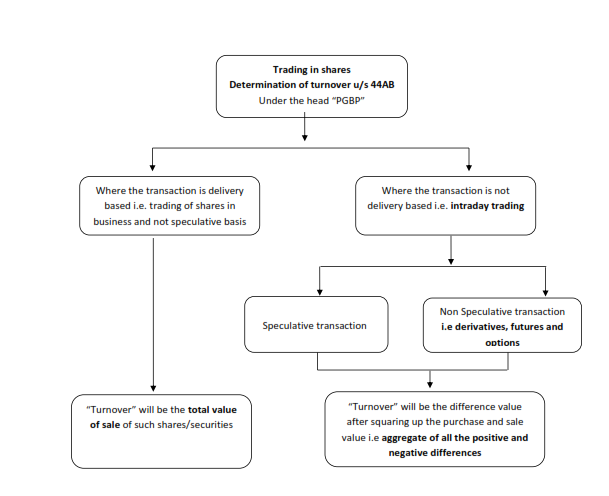
4. How is turnover computed.?
DETERMINATION OF TURNOVER:

                
DETERMINATION OF TURNOVER IN RESPECT OF SPECULATIVE TRANSACTION
Now, your attention may be directed to the Para 5 of “Guidance Note on Tax Audit under Section 44AB of the Income Tax Act,1961" issued by The Institute of Chartered Accountants of India (ICAI), which provides the guidelines regarding "Turnover or Gross Receipts in respect of transactions in shares.." as follows:
a) In a speculative transaction, the contract for sale or purchase which is entered into is not completed by giving or receiving delivery so as to result in the sale as per value of contract note.
b) The contract is settled otherwise and squared up by paying out the difference which may be positive or negative. As such, in such transaction the difference amount is 'turnover'.
c) In the case of an assessee undertaking speculative transactions there can be both positive and negative differences arising by settlement of various such contracts during the year. Each transaction resulting into whether a positive or negative difference is an independent transaction.
d) Further, amount paid on account of negative difference paid is not related to the amount received on account of positive difference. In such transactions though the contract notes are issued for full value of the purchased or sold asset the entries in the books of account are made only for the differences.
e) Accordingly, the aggregate of both positive and negative differences is to be considered as the turnover of such transactions for determining the liability to audit vides section 44AB, whether the differences are positive or negative.
DETERMINATION OF TURNOVER IN RESPECT OF NON SPECULATIVE TRANSACTION
Determination of turnover in case of F&O is one of the important factors for every individual for the income tax purpose. Turnover must be firstly calculated, in the manner explained below:
1. The total of positive and negative or favorable and unfavorable differences shall be taken as turnover.
2. Premium received on sale of options is to be included in turnover.
3. In respect of any reverse trades entered, the difference thereon shall also form part of the turnover.
Here, it makes no difference, whether the difference is positive or negative. All the differences, whether positive or negative are aggregated and the turnover is calculated.
DETERMINATION OF TURNOVER IN RESPECT OF DELIVERY BASED TRANSACTION:
Where the transaction for the purchase or sale of any commodity including stocks and shares is delivery based whether intended or by default, the total value of the sales is to be considered as turnover.
5. When is audit required?
An audit is required if you have a business income and if your business turnover is more than Rs 2 crores (was Rs 1 crore until FY 16/17) for the given financial year. Audit is also required as per section 44AD in cases where turnover is less than Rs.2 Crores but profits are lesser than 8% of the turnover and total income is above minimum exemption limit.
Therefore, the applicability of tax audit will be as follows in case of F&O Trading:
5.1 In case of Profit from transactions of F&O trading
a) In the case of profit from derivative transactions, tax audit will be applicable if the turnover from such trading exceeds Rs. 1 crore.
b) Tax audit u/s 44AB r/w section 44AD will also be applicable, if the net profit from such transactions is less than 8% of the turnover from such transactions.
5.2 In case of Loss from F&O Trading
In case of Loss from derivative trading, since profit (Loss in this case) is less than 8% of the turnover, therefore Tax Audit will be applicable u/s 44AB read with section 44AD.
6. Tax Treatment:
Business income: If you are trading in the stock market frequently (mostly non-delivery trade), returns from it can be classified as follows:
6.1. Speculative Business income:  Profit from intraday trading is categorized under speculative business income. Tax treatment is similar to your Business income tax. It is taxed as per the tax slab you fall in while losses can be offset only against speculative gains. 
6.2. Non-speculative Business income: Income from trading futures & options on recognized exchanges (equity, commodity, & currency) is categorized under non-speculative business income. Tax on share trading in such cases is similar to your business income tax. The profits on F/O trading are taxed as per the tax slab you fall in whereas losses on such F/O trading can be set off against business profit.
7. Treatment of Adjustment for loss
7.1 Loss in respect of non speculative business income:
As per the Section 71 of the Income Tax Act, loss in respect of such business can be set off against any other heads of income including income from speculative business but excluding  income under the head “salaries” of that year.
As per Section 72 of the Income Tax Act, if there is any such loss which is not set off against the above said incomes, such losses are eligible to be carried forward and set off against the other incomes excluding income from salary for a period of 8 subsequent assessment years in the manner as specified in the above order of set off.
7.2 Loss in respect of speculative business income:
As per the Section 73 of the Income Tax Act, loss in respect of speculative business cannot be set off against any other heads of income i.e. it can be set off only against other speculative incomes if any in that year.
If there is any such loss which is not set off, such losses are eligible to be carried forward and set off only against speculative incomes for a period of only 4 subsequent assessment years.

The article can also be seen in http://www.orange.taxsutra.com/articles/639670b576d2dae02d4db2f87da8e3/expert_article